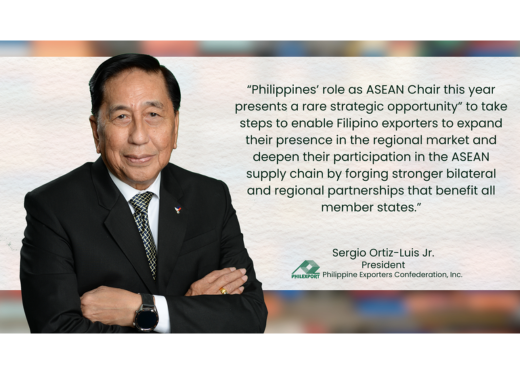
PHILEXPORT president Sergio R. Ortiz-Luis, Jr. in a speech at a business gathering in Makati said the “Philippines’ role as ASEAN Chair this year presents a rare strategic opportunity” to take steps to enable Filipino exporters to expand their presence in the regional market and deepen their participation in the ASEAN supply chain by forging stronger bilateral and regional partnerships that benefit all member states.
He added that to support its exporters, the Philippines should leverage this chairmanship to “push for faster implementation of ASEAN trade facilitation measures, stronger MSME participation in regional trade, practical cooperation on supply chain resilience, and clearer pathways for digital and green exports.”
Ortiz-Luis said bilateral and regional partnerships should move from broad cooperation to “more targeted, sector-driven collaboration” in priority sectors such as electronics, agribusiness, halal products, renewable energy components, creative industries, and services including digital, healthcare and tourism.
He also urged addressing regulatory friction, one of the most significant barriers to trade. The export leader noted that differences in standards, customs procedures, rules of origin, and documentation continue to slow trade in the region.
These hurdles can be resolved by enhancing ASEAN partnerships through stronger commitments to mutual recognition agreements, interoperable digital trade platforms, and predictable border procedures, he said at the February 18, 2026 economic forum outlook.
Ortiz-Luis likewise pushed for strengthening supply chain resilience through diversification. “The Philippines can position itself as a reliable node in regional value chains—particularly in semiconductors, manufacturing support services, and high-value food exports—by building partnerships based on complementarity rather than competition.”
At the same time, the chief executive suggested a number of regional priorities that can benefit the ASEAN export sector. These shared priority areas include sustainability, green and digital initiatives, maritime security, artificial intelligence, and youth engagement.
Noting increasing global demand for traceability, low-carbon production, and ESG compliance, he pressed for deeper ASEAN cooperation in green standards, sustainable logistics, and renewable energy.
It is important as well for ASEAN to accelerate toward a digital single market to reduce export costs, and bolster maritime cooperation and security to ensure smooth trade flows.
Moreover, Ortiz-Luis underscored how crucial it is to forge new ties beyond the region by “deepening engagement with ASEAN Plus partners in advanced manufacturing, clean energy, and digital skills.”
On the national front, he said the Philippine government must strive to strengthen local exports as a “growth anchor” amidst rising global headwinds, supporting domestic enterprises through trade facilitation, access to finance, and market diversification.
It is also vital, according to him, to attract investments not just by addressing corruption and infrastructure gaps but also enhancing policy predictability, skilled labor, and effective public-private collaboration.
Finally, manufacturing and tourism must be supported as key economic engines, as Ortiz-Luis called for the reduction of energy costs, increased logistics efficiency, and upskilling of the workforce, and proposed regional branding to boost tourism as a “powerful export in its own right” for the country.
“For Philippine exporters, strengthening ASEAN partnerships is not just a diplomatic exercise. It is an economic imperative,” he concluded.
March 03, 2026