
The country can strengthen intra-ASEAN economic linkages by reducing trade costs, improving micro, small and medium enterprises (MSME) participation in regional production networks and reviewing non-tariff measures, according to a new study by the Philippine Institute for Development Studies (PIDS).
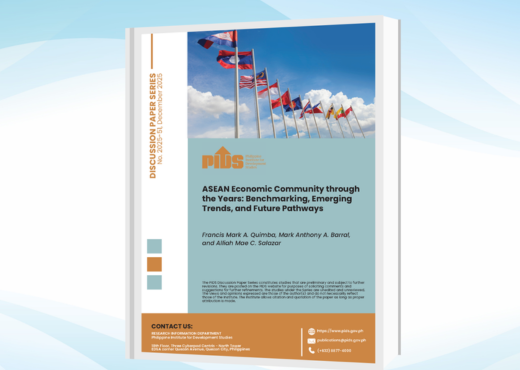
The discussion paper, “ASEAN Economic Community through the Years: Benchmarking, Emerging Trends, and Future Pathways,” authored by PIDS Senior Research Fellow Francis Mark Quimba, Supervising Research Specialist Mark Anthony Barral, and former Research Analyst Alliah Mae Salazar, provides an updated assessment of the ASEAN Economic Community (AEC) Blueprint 2025.
The AEC Blueprint 2025, aimed at fostering deeper regional integration, competitiveness, and economic resilience, has recently been adopted. This as the Philippines prepares to chair the 2026 Association of Southeast Asian Nations (ASEAN) Meetings.
“The participation of MSMEs in ASEAN-wide production networks remains limited. This calls for dedicated technical support, finance access, and regional certification schemes to help scale and integrate MSMEs,” the paper said.
Quimba, Barral and Salazar said that while average tariffs decline, non-tariff measures (NTMs) –such as regulatory inconsistencies, technical standards, and border procedures– continue to impose hidden costs, and have become the main obstacle to deeper intra-ASEAN trade integration.
“A review of existing and emerging NTMs, especially in agriculture, pharmaceuticals, and electronics, should be undertaken with a view toward streamlining and aligning with regional practices and standards,” they said.
The authors said the Philippines benefits from Regional Comprehensive Economic Partnership (RCEP) and ASEAN+1 free trade agreements, however, trade costs remain high due to fragmented border processes.
“Harmonizing customs procedures, mutual recognition of standards, and real-time digital logistics tracking can significantly reduce costs,” they added.
The paper also proposed developing targeted investment corridors in manufacturing, services, and agribusiness that are tailored for ASEAN investors.
“Coordination between BOI (Board of Investments), PEZA (Philippine Economic Zone Authority), and subnational governments can be a key to offering consistent, predictable incentives, and land-use arrangements,” it said.
The study likewise urged faster adoption of digital economy measures through improved regulations, rural connectivity, expanded digital skills programs, and enhanced interoperability across government systems.
It also underscored the importance of enhancing sustainable trade and investment policies and aligning these with climate and green standards, expanding renewable energy and climate-smart agriculture, and engaging proactively in ASEAN-level climate finance mechanisms.
“As global supply chains demand compliance to sustainability standards, the Philippines should introduce carbon border measures, ESG (Environmental, Social, and Governance) incentives for exporters, and labeling schemes that are compatible with ASEAN and EU (European Union) green standards,” the study added.
The private sector, meanwhile, is encouraged to deepen participation in regional supply chains, drive innovation through open collaboration, align with ASEAN sustainability frameworks, and support the green transition of supply chains.
“Firms must diversify regional linkages beyond China and the US. The country must explore other markets and opportunities in its neighbors through strategic joint ventures or co-sourcing agreements,” the authors said.
January 26, 2026