A free training book has been released providing concrete and comprehensive guidance on how Filipino small and medium enterprises (SMEs) can implement circular economy (CE) practices for plastics to reduce production wastage and increase resource efficiency.
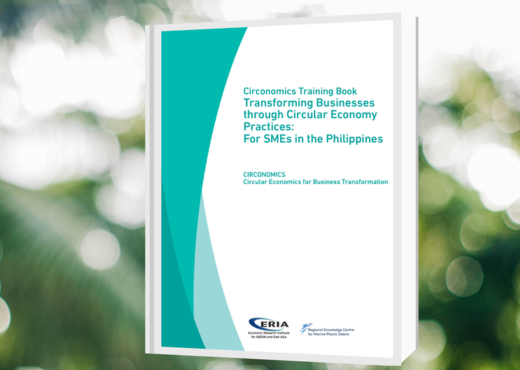
The “Circonomics Training Book Transforming Businesses through Circular Economy Practices: For SMEs in the Philippines” is a practical guide designed to help SMEs in the country and across ASEAN adopt circular economy practices.
The book underscores how circular economy practices can help SMEs in particular to cut costs by maximizing resource productivity and minimizing waste and material inputs. “Resource efficiency can yield significant savings across production and operations as well as contribute to the overall economy of the nation,” it says.
Moreover, embracing CE principles such as reducing waste, reusing materials, and recycling resources can give SMEs a competitive edge. By aligning with circular trends, SMEs can meet supply chain requirements, access green financing, and appeal to a growing base of eco-conscious customers.
“In essence, circular economy is business advantage. SMEs that embrace circular practices can stay competitive and unlock new opportunities,” says the manual.
In contrast, SMEs not practicing circularity can encounter setbacks such as profit leakage since they pay full price for materials they only use once; missed opportunity because they lose further value from a product’s end-of-life through resale, recycling, repair and upcycling; and inefficient inventory due to the lack of reuse or take-back systems, which leads to overstock or wastage.
The paper points out that “reducing plastic waste does not always demand large investments and advanced technologies, and sometimes adopting or taking inspiration from proven practices (best practices) might be more efficient.”
These best practices illustrate that circularity is not limited to global brands, and that SMEs can also lead the way by redesigning packaging, rethinking delivery systems, and partnering with local recyclers or communities.
Some of these proven best practices include stopping automatically giving single use plastic items such as straws, cutlery, or plastic bags unless requested or charging extra for it; removing unnecessary layers of product packaging; motivating customers to bring their own cup or container to restaurants and cafés; and setting up refill stations in sari-sari stores and supermarkets, according to the book.
The document is replete with tips, lessons, directions, and insights from regional case studies, hands-on exercises, as well as step-by-step guidance to help SMEs strengthen supply chains, optimize resource use, and tap into emerging financing opportunities.
In particular, the Best Practices and Localized Solutions section focuses on the primacy of elimination over redesign, saying SMEs should first prioritize the elimination of single-use plastics (SUPs) before moving on to redesign.
If elimination is impossible, businesses should look at redesigning by reconsidering packaging design or using other packaging options that are reusable or biodegradable.
The book authors also dedicate a section to the big challenges circular SMEs face in trying to access external funding and support to develop innovative solutions. This chapter outlines the types of funding available, pathways to secure funding, how to prepare funding proposals, and identifies stakeholders offering support through partnerships and networks.
Finally, the training manual highlights the importance of strengthening regulatory and policy support for circularity adoption by the SME community, noting that “national regulations and strategies for CE remain fragmented, without a unified direction,” with proposals often reactive to current events and with little follow-through on implementation.
The training book was developed by the Regional Knowledge Centre for Marine Plastic Debris under the Economic Research Institute for ASEAN and East Asia or ERIA, and may be accessed at https://www.eria.org/uploads/Circonomics%20Training%20Book%20for%20SME%20Philippines.pdf/.
Circular economy is a system where materials never become waste and nature is regenerated. It is anchored on the cradle-to-cradle approach, which envisions products designed not for a single lifecycle, but to continuously flow within biological or technical cycles. This regenerative model encourages innovation in product design, materials science, and business models to eliminate the concept of waste altogether.
January 21, 2026